
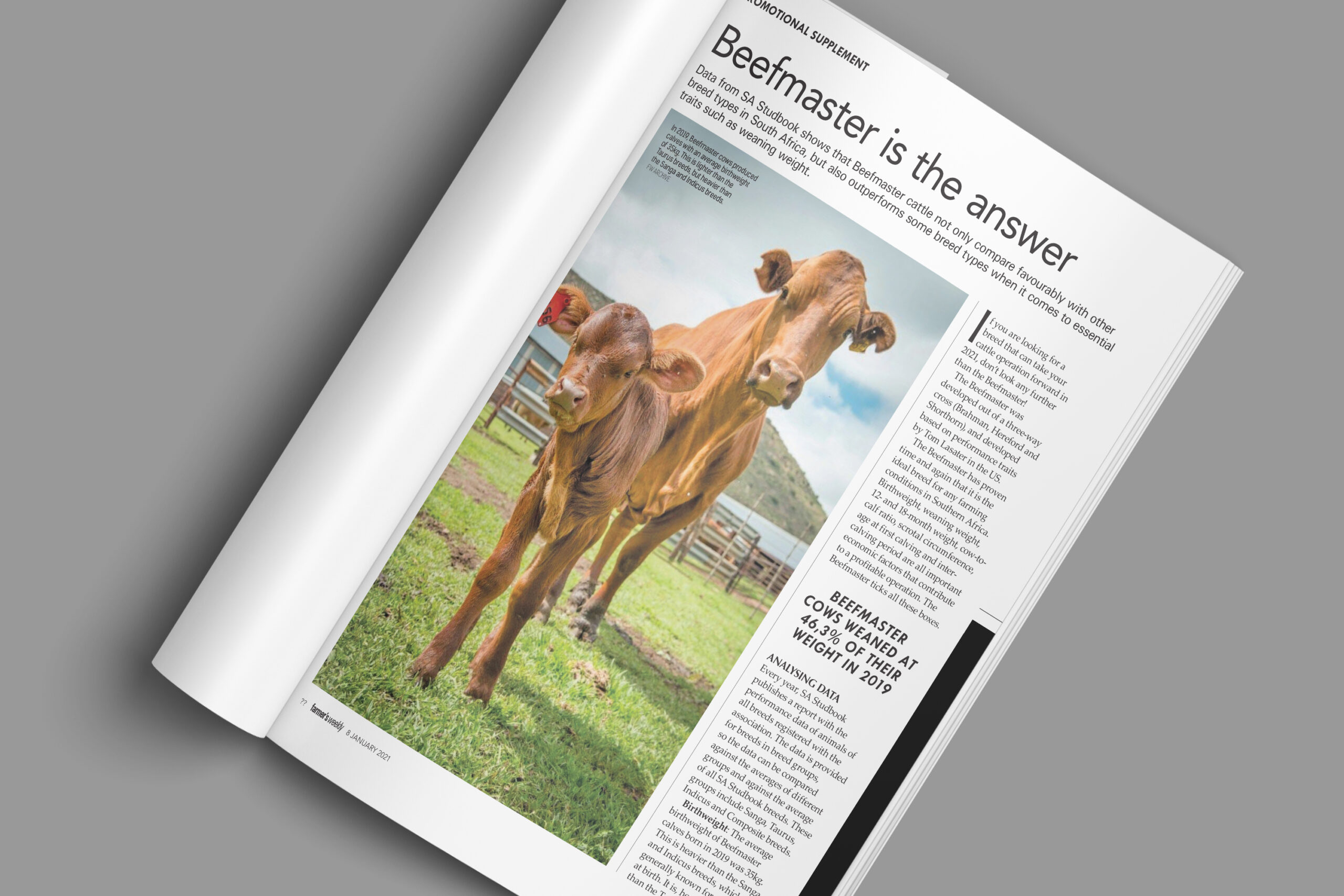
Data from SA Studbook shows that Beefmaster cattle not only compare favourably with other breed types in South Africa, but also outperforms some breed types when it comes to essential traits such as weaning weight.
If you are looking for a breed that can take your cattle operation forward in 2021, don’t look any further than the Beefmaster! The Beefmaster was developed out of a three-way cross (Brahman, Hereford and Shorthorn), and developed based on performance traits by Tom Lasater in the US.
The Beefmaster has proven time and again that it is the ideal breed for any farming conditions in Southern Africa. Birthweight, weaning weight, 12- and 18-month weight, cow-to-calf ratio, scrotal circumference, age at first calving and inter-calving period are all important economic factors that contribute to a profitable operation. The Beefmaster ticks all these boxes.
BEEFMASTER COWS WEANED AT 46,3% OF THEIR WEIGHT IN 2019
Every year, SA Studbook publishes a report with the performance data of animals of all breeds registered with the association. The data is provided for breeds in breed groups, so the data can be compared against the averages of different groups and against the average of all SA Studbook breeds. These groups include Sanga, Taurus, Indicus and Composite breeds.
Birthweight: The average birthweight of Beefmaster calves born in 2019 was 35kg. This is heavier than the Sanga and Indicus breeds, which are generally known for small calves at birth. It is, however, lighter than the Taurus breeds (38kg).
Weaning weight: The average weaning weight for Beefmaster in 2019 was 236kg, which compares favourably against all groups. The Taurus and Composite groups had weaning weights of 227kg. The lowest average weaning weight was from the Indicus breeds at 192kg. The average of all SA Studbook breeds was 222kg.
Twelve- and 18-month weights: These weights are difficult to read into as they are almost entirely dependent on the treatment the animals get and the feed they receive. It is interesting though to calculate the 18-month weight as a percentage of mature weight. The Beefmaster weighs 73,5% of mature weight by 18 months of age. Indicus types weigh 71,6% of mature weight by 18 months of age; Sanga types weigh 66,8% of adult weight.
The bigger this percentage, the better the chance that heifers will conceive.
Cow-to-calf ratio: Weaning weight only tells half the story when you look at kilograms weaned per hectare. That is where the cow-to-calf ratio comes in. The breed with the best cow-to-calf ratio is the breed that will wean the most kilograms per hectare. According to the Logix data, Beefmaster cows weighed 510kg at weaning in 2019. That equates to a ratio of 46,3%. Sanga-type cows weaned 42,6%; Taurus-type cows weaned 40,5%; Indicus-type cows weaned 45,1%; and the Composite breeds weaned 44,2%.
Scrotal circumference: There are very small differences between breeds in this category, especially if adult weight is taken into account.
Age at first calving (AFC): This trait is important for famers who want to breed their heifers at 15 months. Many Beefmaster breeders mate their heifers young with huge success. That is why Beefmaster cows start calving at 31 months of age on average.
Inter-calving period (ICP): Beefmaster cows had an ICP of 393 days during 2019. This compares very well against other breeds. Sanga-type cows had an average ICP of 409 days, while Indicus-type cows had an average ICP of 457 days.
According to this data, it is clear that the Beefmaster combines the above mentioned traits most favourably. There were 50 937 registered Beefmasters in 2019, with 36 209 of these being female animals.
Phone Magda Boukes of the Beefmaster Cattle Breeders’ Society of South Africa on 051 410 0935. Visit beefmastersa.co.za.